Innovation project

Online Video Analyser

A tool designed to help English language learners identify informal video resources that are both interesting and linguistically accessible.

Supported by: Lund University Joint Faculties of Humanities and Theology and LU Innovation

Online Video Analyser project

This project explored the development of an Online Video Analyser (OVA), designed to support English language learners in finding informal video resources that are both interesting and linguistically accessible to them.

Research indicates that many successful learners of English as a foreign language frequently engage with English-language TV series and films, online videos, and other web content in their leisure time. Less proficient learners, on the other hand, often make less use of informal resources for language learning because they have difficulty identifying content that is both at an appropriate linguistic level and aligned with their personal interests.

The idea behind OVA is to enable these learners to be more independent by helping them evaluate the linguistic difficulty of videos that interest them.

I conducted extensive idea-development work and programmed a low-functioning prototype in Python to demonstrate the viability of the analytical approach.

I also mocked up a website to demonstrate how OVA could present its analyses to language learners. The mock-up below illustrates the intended user experience and the way in which different measures of linguistic difficulty could be explained.

Together, these tools can serve in future project stages to communicate the purpose of the tool potential collaborators and investors, how it is intended to function, and how its results can be interpreted.

OVA analyses the vocabulary and overall language difficulty to help you find something to watch that's just right for you.

Illustration of a laptop used in the Online Video Analyser prototype
OVA language difficulty gauge

What is OVA?

OVA judges the difficulty of the language in online videos by using linguistic text analysis. Unlike similar available tools that require users to input the full text for analysis, OVA makes it easy to analyse spoken language in online videos through automatic subtitle extraction. OVA presents the results of the language analysis in a way that is easy to understand for English language learners. 

The analysis mostly focuses on the words that appear in each video. This is because vocabulary is a good predictor of overall difficulty and plays an important role in all four language skills—reading, writing, listening, and speaking. Linguistic researchers consider vocabulary the key to understanding and producing language. Read on to find out more about the meaning of the different metrics used by OVA.

The percentage score

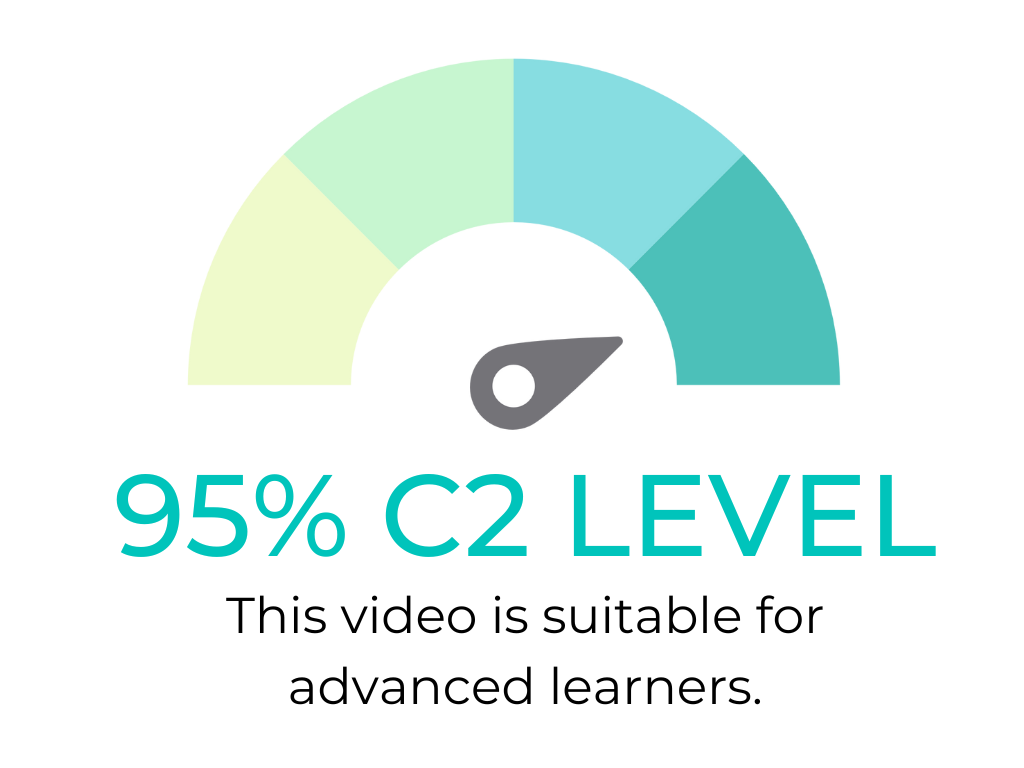
The percentage score indicates the overall difficulty of an analysed video (0% = easiest; 100% = most difficult). This score combines different ways of assessing vocabulary.

Example OVA percentage score
OVA CEFR level graphic

The CEFR level

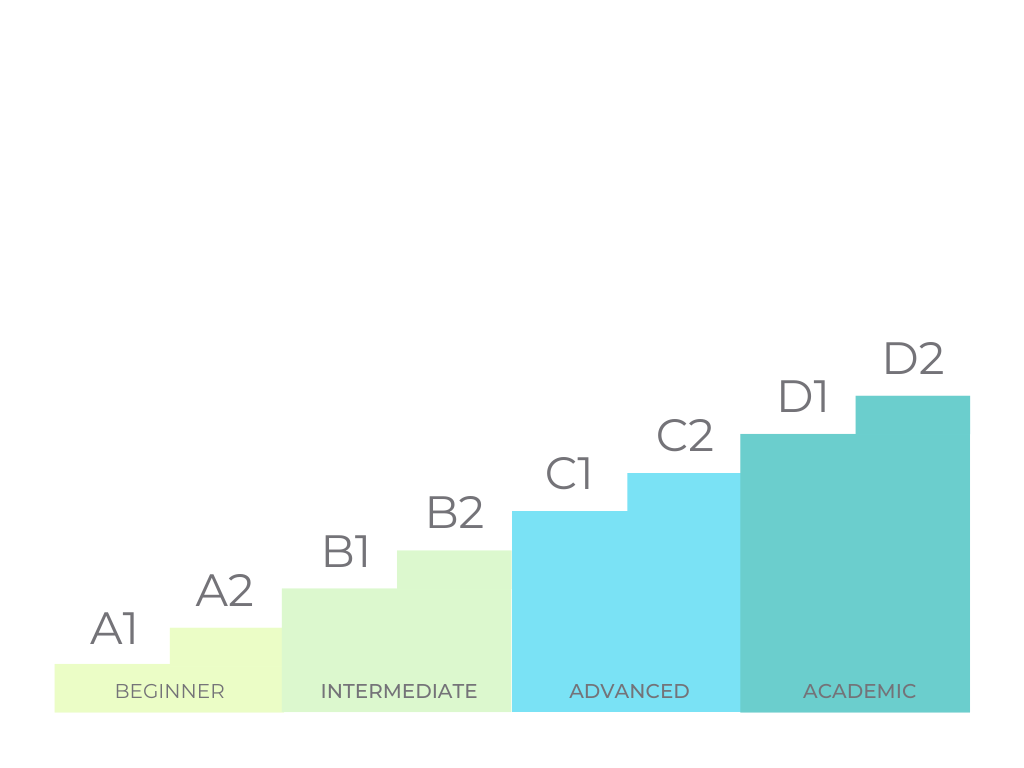
OVA uses Central European Framework of Reference (CEFR) to give learners an indication of how proficient they need to be in English in order to understand a particular video. For example, if you are a lower-intermediate learner, you may wish to find videos at the B1 level and below.

The CEFR framework describes what learners can do at different stages of studying a language in terms of speaking, listening, reading, and writing. The framework describes six levels of proficiency, with A1 and A2 referring to beginner, B1 and B2 to intermediate, and C1 and C2 to advanced learners. Two additional levels are included which refer to use of undergraduate-level (D1) and higher academic language (D2).

If you don’t know your own CEFR level, you can take a look at the official self-assessment grid, or take one of the many placement tests that are available online.

English vocabulary profile

OVA compares the words in a video with the English Vocabulary Profile (EVP) to estimate how much vocabulary learners at different CEFR levels can be expected to understand.

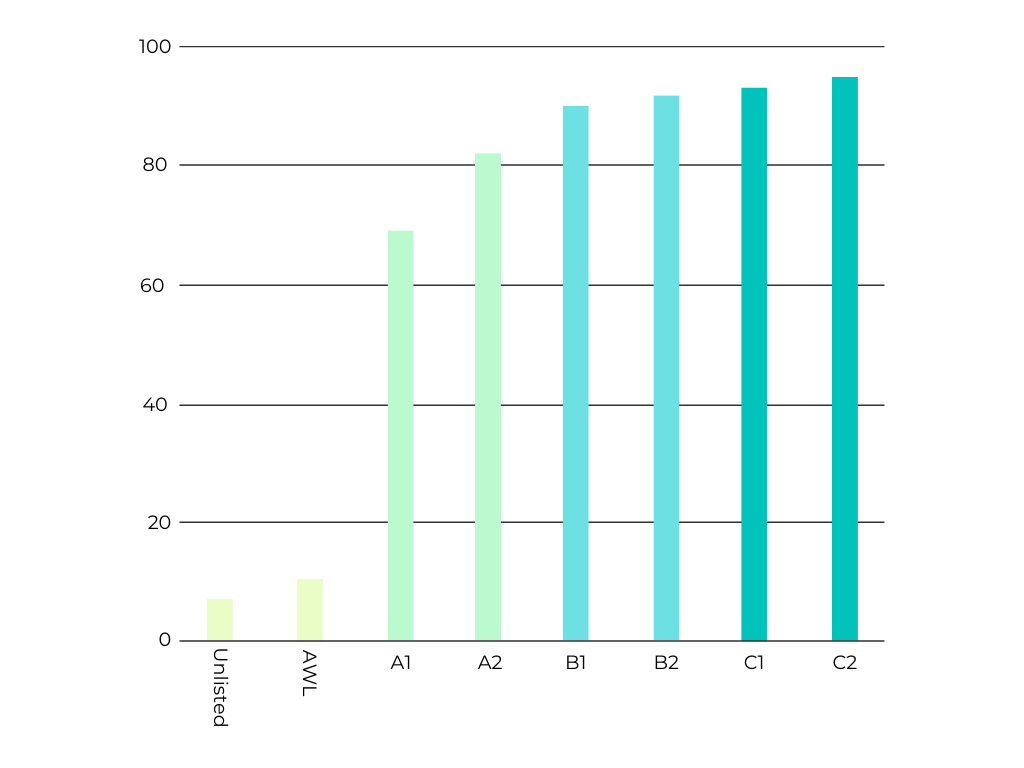
The EVP is a list of words and phrases in English that learners at each of the six CEFR levels should know. OVA compares the words that occur in a given video to the EVP list and lets you know how much of the vocabulary learners at each CEFR level can expect to understand. Research has found that you should know at least 90% of the words in a spoken text in order to understand its meaning.  

On the right is a graph that shows an example EVP analysis: A beginner learner (A1 level) would understand about 70% of the words in this video. A learner with elementary (A2 level) skills would understand about 80%, and so on. The analysis suggests that this video would be most appropriate for a learner at intermediate level (B1) or above, who is likely to know more than 90% of the vocabulary. 

Example OVA vocabulary profile graph
OVA Academic Word List graphic

Academic word list

OVA also searches videos for words in the Academic Word List to help learners understand how formal or academic the language used in a video is.

Unlisted words

Finally, OVA highlights words that do not appear in either the English Vocabulary Profile or the Academic Word List. These may include rare words, specialist vocabulary, slang, or other items that the analyser cannot yet recognise.

OVA unlisted words graphic